
Striped Bass Fishing in the Spring
In the spring, water temperature is the main factor in determining when and where the first striper of the season will be caught. The water temperature will have to get to at least 44 degrees F.
Early Spring Stripers
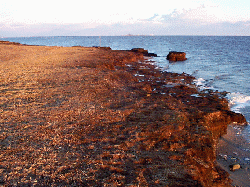
Graveling Point
The following discussion is centered on a particular part of New Jersey. However, similar places and conditions exist at various places along the striper migration route (for example - the shores of Raritan Bay), during the spring with similar results for the fishing; but maybe with timing shifted somewhat.
Graveling Point
Graveling Point is a point on the northern shore of Great Bay, in NJ. Great Bay is fed by the Mullica River. There are shallow flats here, and there is a mud bottom. In the spring this is where the water warms up first. Every year the first striped bass of the season is caught here.
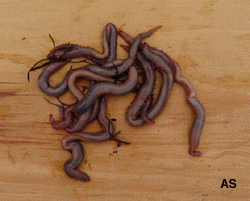
A few sunny days in March will warm the dark mud bottom in these shallows. The worms and other organisms will wake up and become active. As the tide moves in over these warm bottoms, the water will warm. As it recedes with the falling tide, it will be a few degrees warmer than when it came in. This warmer outgoing water, along with the new activity of its bottom dwellers, will attract the stripers. Under these conditions, the first striped bass of the season will be caught. The water temperature will have gotten to at least 44 degrees.
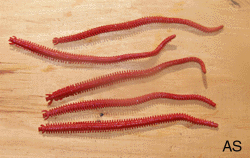
Berkley Gulp
"Bloody" Sandworms
The bait will be bloodworms, Real or artificial Berkley Gulp, or clams, as there aren't many baitfish around this early in the spring. The first stripers won't be large. They will be schoolies and holdovers that remained in these or nearby locations through the winter.
Graveling point is located at the end of Radio Road in Mystic Island. Scott's Bait and Tackle shop is located on this same road. Each year this shop provides a $100 prize to the fisherman who catches the first keeper size striped bass of the season.
A short history showing when the first keeper striper of the year was caught at Graveling Point is provide by the table below.
| Year | Date | Fisherman | Length, in. | Bait |
|---|---|---|---|---|
| 2017 | April 12 | Vincan Kudirca | 30 | White Plastic Swim Shad (lure) |
| 2016 | March 12 | Dylan O'Connell | 29 | Bloodworms |
| 2015 | April 14 | Jake Adair | 28¼ | Clams |
| 2014 | April 19 | Dave Curry | Clams | |
| 2013 | March 13th | Vincan Kudirca | 29 | Bloodworms |
| 2012 | March 8th | Jack Ross | 30 | Blodworms |
| 2011 | March 13th | Tim McGeary | 29 | Bloodworms |
| 2010 | March 16th | Ken Smith | 28½ | Bloodworms |
| 2009 | March 26th | Dan Williamson | 28¼+ | |
| 2008 | March 26th | Lenny Sankarik | 29¼+ | Bloodworms |
| 2007 | March 14th | Mike Barlow | 29 | Berley Gulp Bloodworms |
| 2006 | March 5th | Randy Sloan | 30 | |
| 2005 | March 29th | Lenny Sankarik | 27 |
Note: 1st striper - 2017
Donovan Vasquez caught a 9.4 lb, 30 in. striper in the Mullica River on Wed. March 1, 2017.
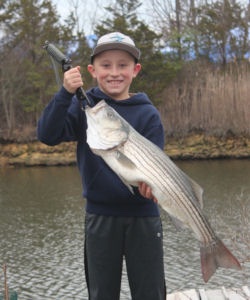
Dylan O'Connell - 2016
A little later, a herring run will occur in the Mullica River as "River Herring" go up the river and its feeder streams to spawn. Larger migrating striped bass now come into the river chasing after the herring and doing their own spawning. Fishermen will be catching the herring in some of the feeder streams and storing them in aerated containers. These fishermen then liveline the herring in the river, and catch some of the stripers. Note that there is presently a moratorium on catching river herring in some New England States.
Since 2012, fishing with river herring is also banned in NJ.
When the stripers come down out of the river some will stay in the back bays for awhile, as the water will be warmer there.
Stripers will begin feeding actively along the ocean beaches when the water temperature reaches 50 degrees. There are not many baitfish along the beaches at this time of year, but there are plenty of clams. So the bait of choice for the surf fishermen is clams, but fresh bunker chunks also work well when you can get them.
Late Spring NJ Stripers
Later in the spring, waves of larger striped bass that are migrating up the coast after spawning in the Chesapeake and Delaware Bays arrive along the NJ coast. These can also be caught using clams or bunker chunks.
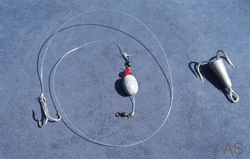
Bunker Snagging Rigs
Link to larger image
However the real excitement occurs when the migrating stripers encounter schools
of live bunker
that invade NJ waters at these same times. The boat fishermen have a blast, and if winds push the bunker close
to the beach, the surf and jetty fishermen can catch large stripers also.
Snag and Drop, using bunker snagging rigs, is the most popular technique used by both boat and surf fishermaen at these times, however stripers are also caught throwing pencil poppers and swimming plugs.
A better way, used by most boat fishermen whose boats have live wells, is to snag a dozen or so bunker and put them in their live wells. Then live line these on separate rods, and using circle hooks to catch the stripers. Follow this link to see Live Lining Bunker.