Boat Fishing For Striped Bass
When the sun comes up in the morning the stripers head out to deeper water. Then the stripers are within range of boat fishermen.
This section has 8 subsections. Don't miss anything, visit them all using the links below!
- Summary: ways to fish for striped bass from a boat - this page
- Boats for striped bass fishing
- Tackle for striped bass fishing
- Bait for striped bass fishing
- Live Bait for striped bass fishing
- Lures for striped bass fishing
- Trolling Lures
- Braided Line
Summary - Boat fishing for striped bass
There are many ways to fish for striped bass from a boat.
These include, but are not limited to, the following:
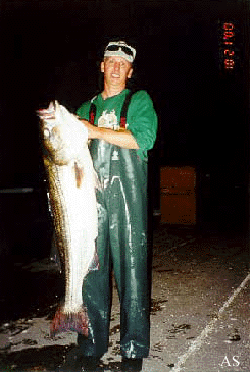
Rob Topham's 39 pound striper
caught in the Delaware Bay
in 2003
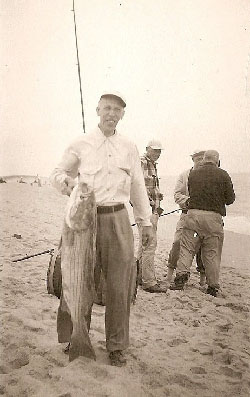
Rob's grandfather caught this
striper at Truro Beach, Cape Cod
in 1951
1. Dunking bunker chunks. while anchored. The 39 pound striped bass shown on the right was caught from a 21 foot boat while anchored in Delaware Bay. The bait was a bunker head. Chumming was used.
2. You can also fish with clams while anchored. Boat fisherman who fish their local waters often, especially charter captains, get to know where all the clam beds are in their area. In the days after a storm, these fishermen anchor over these clam beds, and fish using clams for bait. They know that the storms stir up the clam beds, and that stripers will be there feeding on broken clams.
3. Live lining bunker. This often
involves snagging bunker, then fishing them live.
Most boat fishermen snag the bunker using a treble hook, place them in a live well, then fish them on another rod rigged with a circle hook.
4. Drifting over structure or lumps on the bottom. Live eels are often the bait of choice. Greg Myerson caught his world record striped bass drifting a live eel near a submerged boulder.
5. Jigging with diamond jigs or other lures. This is a good choice when sand eels are the prevalent bait.
6. Trolling deep diving lures, like Mann's Stretch 25s.
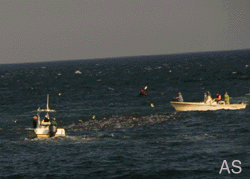
7. Trolling bunker spoons, surgical tubes with worms, umbrella rigs, or parachute rigs. If the fish are really deep this may require the use of wire or lead core line to get the lures deep. Planar boards are often used to keep lines from crossing and away from the boat. See photo below.
9 Casting plugs or other lures close to bars, shore points, or jettys.
10. Drifting live bait like spot. Down off of Virginia Beach some fishermen drift live eels under bobbers.
11. Live lining herring in rivers in the spring.
12. Casting plugs or other lures to the edge of sod banks within the many estuaries along the east coast. This works best in the early hours before sunrise.
13. Fishing near bridge pilings, for example at the Chesapeake Bay Bridge - Tunnel.
14. Chasing birds, and fishing blitzes during both the spring and fall migrations. Snag a bunker or throw a pencil popper.
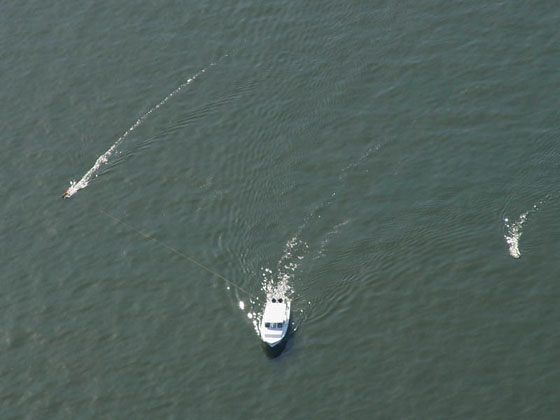
Trolling for striped bass using planar boards in the Chesapeake Bay.
Photo by Keith Lockwood.