
Live Bait
Descriptions of Live Bait For Striped Bass Fishing
Eels

Throwing eels is similar to plug fishing, but instead of a plug you use live eels. Eels are pretty tough and will stay alive for quite awhile, and they will stay on the hook. Eels can be cast with no additional weight, but to cast them further you can add an egg sinker. Thread it and a bead on the line above a swivel and a length of leader, as in Colorado rigging for largemouth bass. From the shore, after casting, slowly retrieve the eel along the bottom.
Live eels are also a good bait to use for drift fishing through inlets, or over rips. Greg Myerson caught his world record striped bass drifting a live eel over a submerged boulder, near the Outer Southwest Reef off the coast of Westbrook, Connecticut.
In the waters in, and around the mouth of the Chesapeake Bay, lots of stripers are caught by fishermen fishing live eels under bobbers.
A good way to hook an eel is through the mouth, and out the bottom of the chin.
Eels do not need to be kept in water. They will stay alive for some time if you just keep them cool. Also If you keep them cool, they do not squirm and twist as much as you put them on the hook.
River Herring
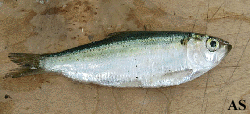
In the spring herring come into the bays and rivers and go up tidal creeks to spawn. The stripers are right behind them. The stripers are spawning too, but they love to eat herring. Herring are sometimes called "Striper Candy". The herring can be caught with nets in the tidal creeks as they bunch up near narrow spots or come upon a dam. Fisherman would net the herring and store them in aerated containers. They then used them as live bait in the rivers where the stripers are spawning.
This is a very effective way to catch stripers. However, catching female stripers full of eggs before they spawn is not for me.
In recent years herring have become scarce. A moratorium on catching river herring has been instituted in most states.
Link to more about: River Herring
Sea Herring
Another species of herring called Atlantic Herring or Sea Herring roam the oceans and are quite different. Follow this link to see about: Sea Herring.
Live Bunker
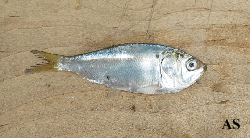
In the fall, juvenile bunker ( peanut bunker ) come out of the bays and estuaries and appear all along the coast. They are often found in tight bunches near the surface and sometimes in close to the beach.
Fishermen cast into the school of bunker, and snag them, using a bunker-snagging -rig. A bunker-snagging-rig can be a weighted treble hook, or a treble hook with an egg sinker located about 15 inches ahead of it. Once snagged the bunker are reeled in and used for live bait on another rod. Some just let the snagged bunker drift to the bottom, and then catch the strippers on the same treble hook. Both techniques work and they are also used by boat fisherman on pods of bait further from the beach.
To see a photo of two types of bunker snagging rigs, follow this link: Bunker Snagging Rigs.
To see more about fishing peanut bunker live follow this link:
At
Mantoloking.
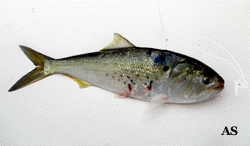
Adult Bunker
You can also catch, and fish, live adult bunker in much the same way. Striped bass can be found feeding on schools of adult bunker in the spring, and early summer, as the stripers migrate north and again in the fall as the sripers come back south.
A good way to hook live bunker is through the back, just in front of the dorsal fin.
Follow this link to see more about: Catching Striped Bass On Live Adult Bunker
Follow this link to learn more about Bunker: Bunker|Menhaden.
Spot
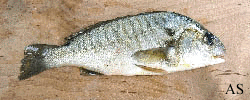
Spot - link to larger image
Spot are an excellent bait to fish live for striped bass, mostly from boats. Spot are expensive, but some fisherman pay the price. Stripers love spot.
To hook a live "Spot", put the hook through the open mouth and out behind the upper lip.
Link to more about Spot: Spot
Mullet
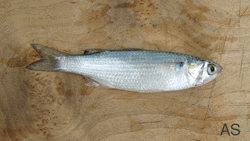
Mullet
In the early fall, around the middle of September in NJ, there is a mullet run. The mullet are often close to shore and tightly bunched, and are therefor easy to catch with a cast net.
Bluefish love mullet, and when you use them for bait, the bluefish grab them before any stripers around get a chance. Besides, most stripers are still further north. The mullet leave in early to mid October, before the stripers show up.
Mullet are more often fished fresh rather than live.
Follow this link to see some suggestions on rigging mullet to catch bluefish: Mullet Rigging.
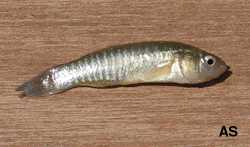
Live Bait Sources
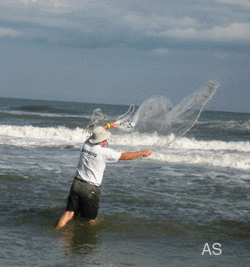
When the bait runs occur along the beach, John and I often catch our own live bait using a cast net. We keep the bait alive in 5 gallon pails with a portable aerator. These aerators have an air stone which you drop into the pail of water, and the battery operated pump is hung on the side of the pail. These work OK if the number of baitfish is limited to about two dozen, and if you don't keep them too long. Change the water once and a while if you can. Last year during a power failure, I used one to keep the tropical fish alive in my aquarium, until the electricity came back on.
If you have a boat, it may have a livewell built in to hold bait. The best ones have raw water circulation.
Live bait is often available from local bait and tackle shops.
How To Throw a Cast Net
Throwing a cast net is not hard. You can get an idea of how to do it from photos, like the one of Captain Dave Showell throwing a cast net above. To see more, and larger, photos of Captain Dave throwing a cast net follow this Link: Cast Net