
Striped Bass Fly Fishing
This section provides information about fly fishing for striped bass. Many of the baitfish the stripers are chasing are small, like silversides and sand eels, which are best imitated with saltwater flies.
Use the navigation bar on the left to access the different branches of the fly fishing section. This is the Flies branch.
Striped Bass Fishing Flies
There are many saltwater fly patterns that work great for catching striped bass. A few of the most popular striped bass fishing flies are described below.
Lefty's Deceiver
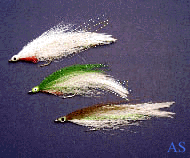
The Deceiver is the most widely used and imitated saltwater fly.
It is a versatile fly that can imitate many baitfish. The side to side parallel
wing feathers present a narrow profile that casts well, and minimizes the chance of fouling.
It is easy to tie with a minimal amount of materials. The Deceiver is named after
Lefty Kreh who developed this fly. More than 100 species of fish have been caught on
Deceiver flies.
Lefty suggests a, 2 or 3 strip and pause, 2 or 3 strip and pause,
stripping sequence. Fast for bluefish, slower for stripers. Try varying the pace.
Link to see more about: Lefty's Deceiver
Clouser Deep Minnow
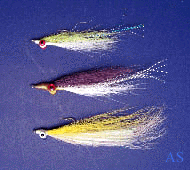
The Clouser is a weighted fly; the weighting being achieved by using metal
dumbell eyes. Bob Clouser developed this fly that goes by his name. He designed it in 1995 to
catch smallmouth bass on the Susquehanna river. Over 83
fresh and saltwater species have been caught on the Clouser.
Bob Clouser suggests a strip, accelerate and
pause stripping sequence. At the end of the strip
the acceleration frees the fly from the leader and at the pause the fly drops. Then strip again.
The strikes come on the drop. He calls this the Susquehanna Strip.
Link to see more about: Clouser Deep Minnow
Follow this link to see: Clouser Deep Minnow Flies on Amazon.com
Half and Half
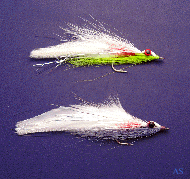
Bob Clouser designed a larger weighted fly by combining the hackle type wing from the Deceiver with the metal dumbell eyes of the Clouser Deep Minnow. L.L. Bean refers to this fly as the Kreh/Clouser Half and Half.
Jiggy
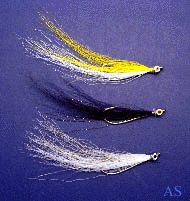
The Jiggy is also a weighted fly; this being achieved using a metal
bullet shaped weight, which becomes part of the head.
It is similar to the Clouser, but is
considered more durable for dragging along an ocean bottom.
The Jiggy yields a streamlined silhouette, and its weight makes it enticingly drop between strips. The jiggy was developed by Bob Popovics.
Link to see more about: Jiggy Flies
Surf Candy
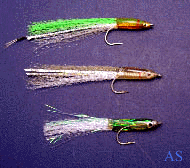
The Surf Candy is an epoxy fly. It has a shaped, translucent baitfish-like epoxy body that is very rugged. It is a good choice to use when those toothy bluefish are present. The Surf Candy is another Bob Popovics' design.
Link to see more about: Surf Candy Flies
Link to tying shaped flies using Tuffleye Acrylic Resin: Tuffleye Acrylic Resin
Bob's Banger
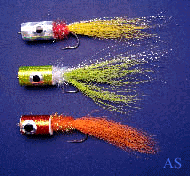
Bob's Banger is named after Bob Popovics, it's creator.
It's popping action is designed to make a noisy commotion to attract fish. The key to
fishing the Banger is to pop it along the surface with no pauses. This fly
is also deadly on bluefish, and can withstand their brutal assaults.
Bob Popovic
recommends working this lure with your line hand, not the rod. Sometimes subtle pops work
better than loud noisy ones.
Link to see more about: Bob's Banger Flies
Captain Ray's Flies
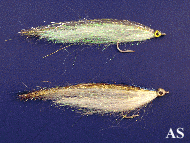
Captain Ray Stachelek has achieved much success tying saltwater flies with
synthetic materials such as Ultra Hair and Angel Hair. Two examples are shown on the right.
The top pattern is a Silverside.
The pattern on the bottom ia a Bay Anchovy.
Link to see more about: Captain Ray's Flies.
Mushmouth Flies
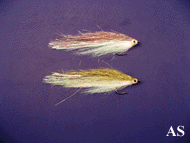
These Mushmoth Flies designed by Dave Skok are non-fouling,
quick-to-tie baitfish imitations.
They are tied with synthetic materials such as Super Hair and Angel Hair.
Link to see more about: Mushmouth Flies.
Peanut Butter Fly
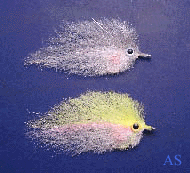
Enrico Puglisi's "Baitfish Imitation" series of flies feature a full
bodied, wide profile shape, which has proven effective in catching bonefish, tarpon, and yes, striped bass.
The pattern shown is the Peanut Butter.
Enrico says the best way to fish these flies
is with slow strips and short twitches.
Link to see more about: Peanut Butter Flies.
Peanut Bunker Fly
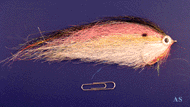
Steve Farrar ties some large flies using a material that is a blend of Angel Hair and Kinky Fibre. This blend has a semi-coarse texture and a fine "Angel Hair" flash. It holds it's shape and silhouette in the water, making it a good choice for making full bodied flies like those that represent peanut bunker.
Link to see more about: Peanut Bunker Flies.
Hollow Fly
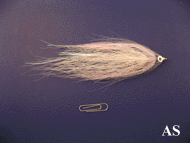
This Hollow Fly, tied by Bob Popovics is another nifty bunker pattern. It was tied using bucktail.
Bob prefers bucktail because it has a natural taper that helps with the shaping of the fly and gives the fly movement in the water.
Link to see more about: Hollow Flies.
Teasers
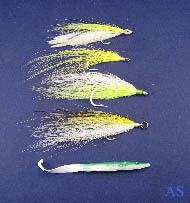
When casting lures, I often use a teaser on a dropper loop ahead of the lure. These can be simple streamer flies tied with bucktail as shown by the middle three on the right. Any color is OK, as long as it's yellow.
Sometimes I will use a Deceiver fly (top) as a teaser, if I have some extras, or beat up ones.
The teaser on the bottom is a "Red Gill"; somewhat famous for imitating sand eels.
Teasers do add some drag. If you need to cast really far, or into the wind, omit the teaser.
Link to see more about: Teasers